OpenAI is testing an ad you can argue with. In a blog post published Wednesday, September 16, 2026, the company introduced Sponsored Agents: a ChatGPT ad that a user can click to open a separate, clearly labeled conversation with an AI agent the advertiser sponsors. The same post plugged ChatGPT Ads into HubSpot and Shopify — named as OpenAI's first CRM partner and first ecommerce partner respectively — and added tools that let advertisers build, edit and analyze campaigns by typing prompts instead of filling in forms. PYMNTS and Unite.AI both reported the announcement on September 16; PPC Land published a detailed breakdown on September 17.
Announced September 16, 2026. Sponsored Agents are in test with select advertisers in the United States only. HubSpot integration is live from the same date; the Shopify app is US-only now and goes international in ChatGPT Ads markets starting September 23. OpenAI has not said what a Sponsored Agent costs, how it is measured, or what the advertiser sees from the conversation.
What a Sponsored Agent actually is
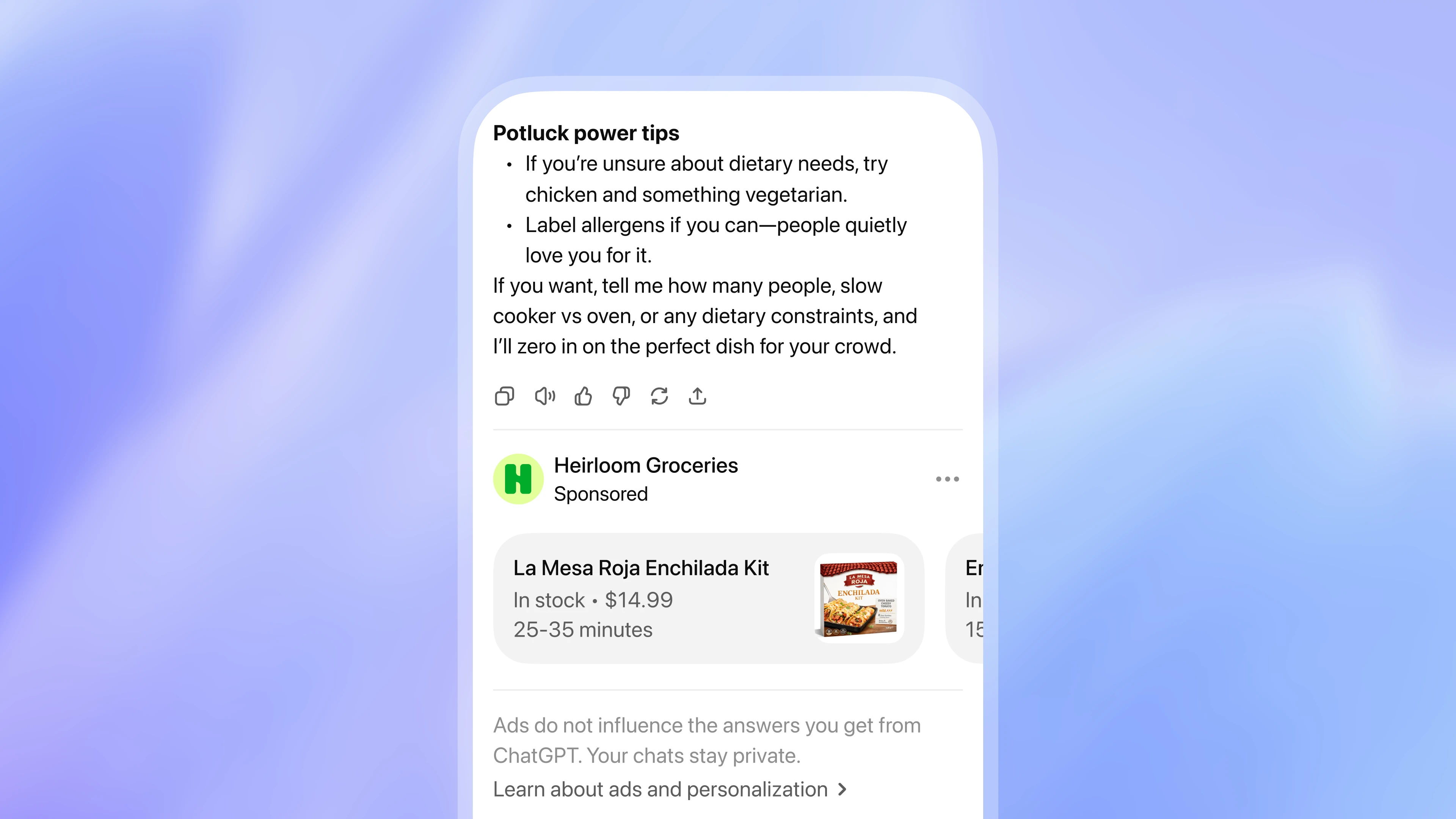
Until now, a ChatGPT ad has been a card. Per PPC Land's reading of OpenAI's own documentation from when self-serve buying opened on May 5, 2026, the unit is an advertiser name, a favicon, a headline of roughly 16 characters, a description of roughly 32, an image and a landing page — appearing at the foot of an answer, and since August in carousels. It behaves like a search ad.
A Sponsored Agent turns that card into a door. "Sponsored Agents give users the option to go deeper," OpenAI wrote in the post, as quoted by PYMNTS. "After seeing a relevant ad, a user can choose to start a clearly labeled conversation with a business-sponsored agent in ChatGPT. The user can explain what matters to them, ask follow-up questions and follow a link to the business's website when they're ready to take the next step." OpenAI's worked example, reported by both Unite.AI and PPC Land, is domestic and deliberately dull: a shopper sees a dining table in an ad and wants to know whether it fits the room, how many people it seats, and how to care for the finish.
That is closer to a messaging ad than to anything ChatGPT has carried before, and it is the second such move in a week. PPC Land notes that Amazon Ads opened a pilot on September 10 extending Amazon DSP campaigns into ChatGPT, with Amazon's director of omnichannel supply, Chris Conetta, calling conversational ads the fastest-growing engagement opportunity for brands. Six days later the owner of the surface built the conversation into the ad itself.
The separation problem OpenAI set itself
When OpenAI confirmed advertising on ChatGPT in January 2026 — PYMNTS notes the company said then that testing would begin within weeks — it promised ads would be clearly labeled and kept apart from organic answers. A conversation with an advertiser's own agent is, by construction, a harder version of that promise to keep.
OpenAI's answer is architectural. "The conversation with a Sponsored Agent is distinct from ChatGPT's independent answers and separate from the original conversation that the user started in ChatGPT," the company wrote, per PPC Land. The user opts in by clicking; the sponsored thread does not merge back into the chat they were already having. That preserves the letter of the separation principle. Whether it holds in practice depends on details the post does not address.
PPC Land flags exactly that gap, and adds a wrinkle: an email OpenAI sent advertisers the same day, published by Search Engine Roundtable, was more tentative than the public post, describing a conversation users may be able to start rather than one they can. Both documents carry the September 16 date. There is also no stated price. On a surface where every other unit is billed by impression or click, nobody outside the test knows what a sponsored conversation costs.
Measurement is the harder question
ChatGPT's entire ad measurement stack is built on two events: an impression and a click. A conversation produces neither in a form that fits a reporting column. Is the outcome the click that opens the agent, the number of turns the user takes, the link they follow, or a sale that lands later on the advertiser's own site? OpenAI has not said.
The rest of this week's changes make that silence more conspicuous, because they are all about measurement. Per PPC Land's account of the advertiser email, conversion optimization with impression billing is now generally available and is OpenAI's recommended performance model — a reversal, within about a month, of the position it held in August when view-through conversions shipped with a fixed one-day window and were kept out of bidding and billing. Attribution windows are now configurable to 7, 14 or 30 days for clicks and 0 or 1 day for views. Platform targeting has been split five ways: Android app, Android web, desktop web, iOS app and iOS web. And a new Event Quality Score under Tools grades Pixel and Conversions API data sources from 1 to 10. Every one of those is an answer to "did this work." Sponsored Agents arrive without one.
HubSpot and Shopify are the real distribution story
The partnerships are less glamorous than talking ads and probably matter more. "Adopting a new advertising channel shouldn't require businesses to rebuild the way they work," OpenAI wrote, per PPC Land. HubSpot customers can now connect a ChatGPT Ads account and create ads, track performance and follow up on leads without leaving HubSpot; HubSpot published its own release over Business Wire the same morning claiming it is the first CRM to integrate with ChatGPT Ads, with OpenAI's vice president of global partnerships, Brian Landsman, quoted in it.
There is money attached. PPC Land reports the two companies are offering an "AI Growth Bundle": HubSpot Starter and credits at up to 65 percent off for a year, a buy-one-get-one-free offer on ChatGPT Business seats for a year, and a $750 match on ChatGPT Ads spend for new accounts opened by September 30. That is an acquisition subsidy with a two-week clock on it.
The Shopify side is quieter and more revealing. The ChatGPT Ads app is free, lists OpenAI as the developer, and — per the App Store listing PPC Land and Unite.AI both checked — carries a release date of September 3, 2026, thirteen days before the announcement. It syncs product inventory, builds ads from the catalog, and runs campaigns using a Shopify pixel and conversion events. The listing's permissions are worth reading before installing: PPC Land reports the app reads customer names and email addresses, IP addresses, browser and operating system details, browsing behavior and a client ID cookie, and can edit marketing events, web pixels and server pixels.
This is also OpenAI's second run at Shopify's merchants. Instant Checkout, which opened in September 2025 with Stripe and let users buy inside the chat, was shut down in March 2026 after Walmart disclosed that in-chat conversion rates ran roughly three times lower than for shoppers who clicked out to its own site, according to PPC Land. Catalog-to-checkout failed; catalog-to-ad is the retry.
How big the channel already is — with caveats
The numbers explain the urgency. The pilot opened on February 9, 2026. By August 31, OpenAI said ChatGPT Ads had reached a $1 billion annualized revenue run rate and was "used by tens of thousands of advertisers," per the press release PYMNTS quoted, with direct Ads Manager buying opening across India, Europe, the Middle East and North Africa that day. PPC Land cites Digiday's derivation of that figure from roughly $83 million in monthly revenue, and a Similarweb estimate from August 17 that 26 percent of ChatGPT responses shown to Free and Go users carried a sponsored placement.
Treat all of it as directional. As PPC Land puts it plainly, every figure in that sequence is either self-reported by OpenAI or estimated by a vendor from a panel, and none has been independently verified.
Europe is a separate fight
One constraint is already visible. PPC Land reports that the European Commission designated ChatGPT a very large online search engine on August 31, 2026, after OpenAI declared 159.1 million users, with the additional obligations falling due four months after notification. Personalized advertising was withheld when ads reached Europe, and OpenAI told EU users on August 15 that ad selection draws on the current chat topic, general location and device type only. The new opt-in text customization — which rewrites headlines to fit the conversation and translates them into the reader's language — leans on that first signal. How far that can go in the EU is not settled.
Can I use Sponsored Agents right now?
No. OpenAI says the format is being tested with select advertisers in the United States. The campaign-building tools, creative suggestions, text customization and the HubSpot and Shopify integrations are the parts rolling out more broadly, and even there OpenAI's advertiser email described some features as still in testing.
Does this mean advertisers can see my ChatGPT conversations?
OpenAI says a Sponsored Agent conversation is separate from your original chat and from ChatGPT's own answers, and the company has previously committed to keeping conversations private from advertisers. What it has not said is what the advertiser receives from the sponsored conversation itself. Until it does, assume anything you type to a brand's agent is going to that brand.
Do paying ChatGPT users see ads?
Ads on ChatGPT have run on the Free and Go tiers for logged-in adult users since the February 2026 pilot. OpenAI's September 16 post does not announce any change to that.
The through-line of the past seven months is that OpenAI is building a full advertising business at a pace that leaves the measurement and policy scaffolding trailing behind the product. Sponsored Agents are the clearest example yet: a genuinely new ad format, shipped into a test, with the pricing, the reporting and the data terms all still blank. Those blanks will decide whether an ad you can talk to reads as useful or as a trapdoor.