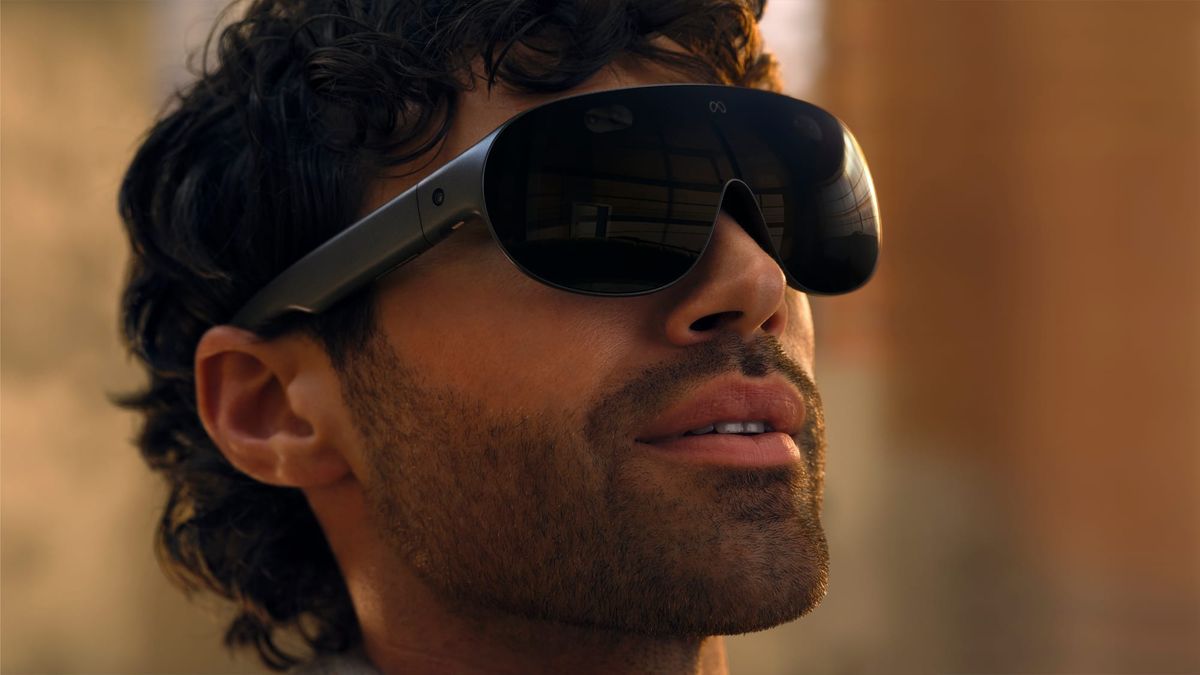
Meta used its Connect 2026 keynote to show the headset it wants to replace the headset. Meta VR Glasses, announced September 23, put two micro-OLED displays into a roughly 100-gram frame and move everything else, including the chip, battery and storage, into a separate puck on a cable. Per Meta's own announcement, the device will be "available in Spring 2027 for $1,299.99 USD." That makes it Meta's most expensive consumer headset by a wide margin, and a very different bet from the Quest line.
The pitch is weight. Meta says that "at about 100 grams, Meta VR Glasses are five times lighter than Meta Quest 3." The tradeoff is also clear from the spec sheet: a much narrower field of view than Quest 3, a three-hour battery, and a 300-gram puck you have to carry somewhere on your body. Here's what Meta announced, what the first hands-on reports say, and what's still unknown.
What Meta actually announced
Meta's blog post describes a "5K Infinite Display built on micro-OLED panels." UploadVR's David Heaney, writing the same day, filled in the per-eye numbers: dual 2412×2288 HDR micro-OLED panels running at up to 120Hz, with a central angular resolution of 37 pixels per degree. UploadVR calls it the highest-resolution Meta headset to date. It's also Meta's first VR headset with OLED-class panels since the original Quest in 2019, per the same report.
Compute sits in the puck. According to Engadget's Connect roundup by Kris Holt, the puck runs Qualcomm's Snapdragon Reality Elite chipset and also houses the storage and battery. UploadVR lists 12GB of RAM, 128GB of storage and a microSD slot. The glasses and puck connect through what UploadVR describes as a "thin and flexible hybrid fiber optic cable." Meta rates the battery at "up to three hours of continuous high-resolution media playback" per charge, per Engadget, with 45W fast charging.
The frame is magnesium alloy with pancake lenses, and it supports full-color passthrough, Dolby Vision and Dolby Atmos spatial audio, per Engadget. Meta also claims it's "the first IMAX Enhanced certified VR device." Tracking covers eyes, hands and face. UploadVR reports four-camera eye tracking.
$1,299.99, spring 2027 (per Meta). ~100g glasses plus a 300g puck on a fiber-optic tether (per UploadVR). 2412×2288 micro-OLED per eye at up to 120Hz, 37 PPD center, 70° × 66° field of view. Snapdragon Reality Elite, 12GB RAM, 128GB + microSD. Up to 3 hours of media playback per charge. Controllers not included.
No controllers in the box, but Quest content comes along
Meta is presenting this as a controller-free device. Its blog says navigation uses "eyes and hand gestures, instead of using controllers," and Engadget reports that 75 games will support hand gestures at launch. Controllers are still an option: UploadVR says Touch Plus controllers are sold separately and existing Quest 3 and 3S controllers also work.
The bigger point for anyone with a Quest library is software. UploadVR reports that the glasses run the same operating system as Quest 3 and "support all the same content." If that holds at launch, Meta VR Glasses start with a real catalog. Most new headset platforms have to build one from zero. UploadVR also notes USB-C DisplayPort input, so you can use it as a display for phones, laptops and handhelds.
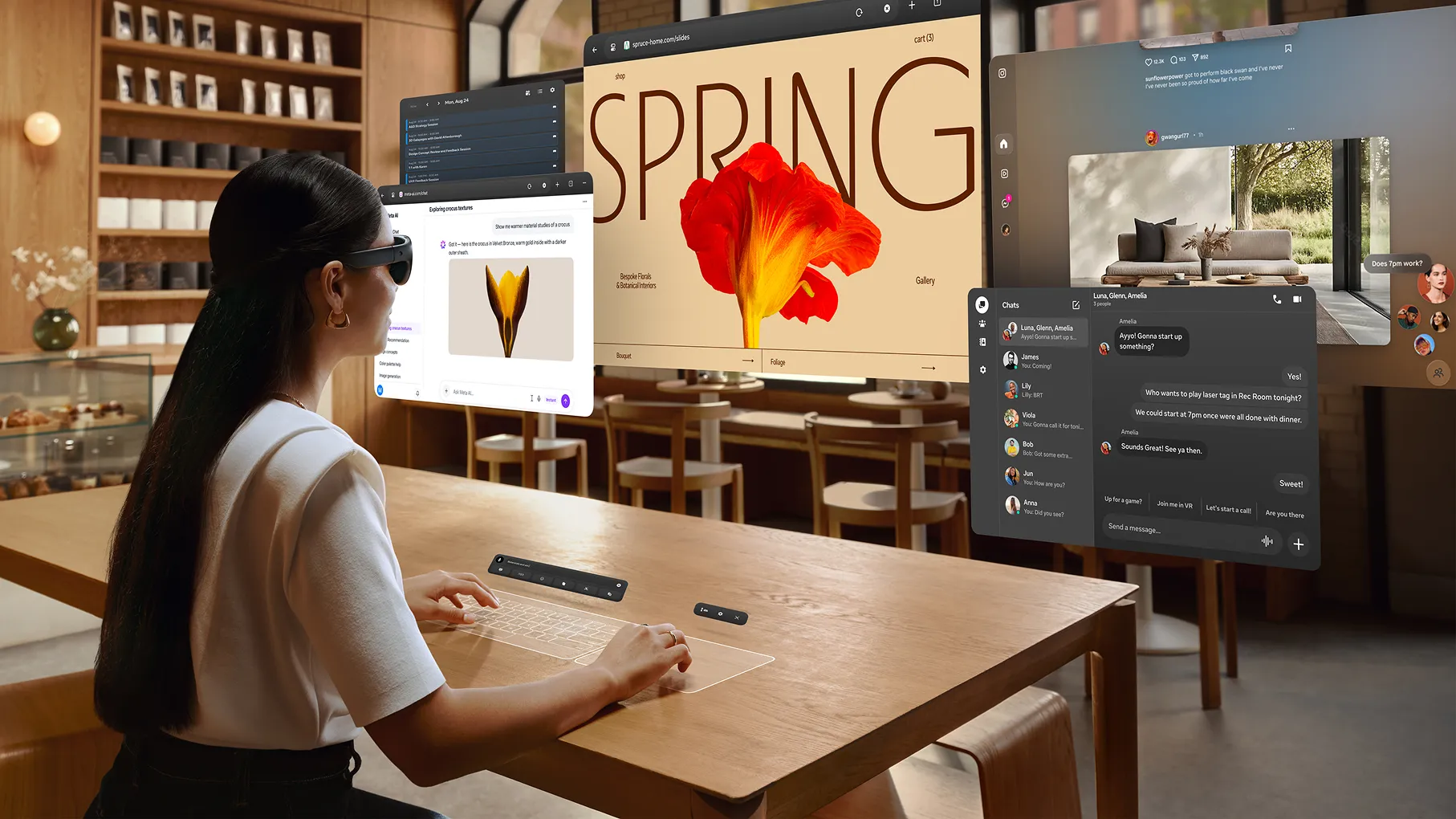
Beyond games, Meta is leaning hard on media and work. The blog describes "multi-panel virtual displays with surface input built in," which means you can turn a tabletop into a keyboard. Engadget reports Xbox Cloud Gaming streaming and virtual desktop support for PC and Mac. Meta named Disney+, YouTube, HBO Max and Prime Video among supported apps. Engadget also reports that a Disney Immersive Cinema by ILM app will offer "VR Enhanced" films on the glasses starting in spring 2027, and that live sports deals with MLB, NBC Sports, TNT Sports and UFC will cover more than 100 events a year.
Meta is also bringing its photorealistic avatar work to the device. The company says a "photorealistic, real-time digital representation of you" will launch with the glasses in spring 2027, for calls on WhatsApp and Zoom per Engadget. Meta Ray-Ban Display owners get early access on WhatsApp first.
The tradeoff: a 70-degree field of view
Getting down to 100 grams costs field of view. UploadVR puts it at 70° horizontal by 66° vertical, compared with what it describes as Quest 3's "roughly 110° horizontal × 96° vertical." Anyone coming from a Quest will notice the difference, and it matters most in games that rely on peripheral vision.
Road to VR's Scott Hayden, who tried the glasses at Connect, called the field of view "noticeably smaller than Quest 3's 110-degree FOV." He also flagged audio: the off-ear speakers have "less bass" and some "audio bleed." Sizing was another concern. Hayden had fit problems during the demo and worried that buyers could order the wrong size unless Meta gives clearer guidance before launch.
The hands-on praise was just as specific. Hayden called it the "best color passthrough I've seen on a standalone VR headset," with no visible stitch lines or latency. He also said the hand-tracking UI let him "put hands in lap and do all UI gestures" without holding his arms up, which has been a common complaint about gesture-driven headsets.
Where it fits in Meta's lineup
Meta VR Glasses weren't the only hardware news at Connect. Per Engadget, Meta also launched Ray-Ban Meta Gen 3 starting at $449, a camera-free Ray-Ban Meta Audio model starting at $349 that ships October 13, and a Meta-branded Adventurer model starting at $249. It also announced updates to the $799 Meta Ray-Ban Display. Meta's AI agent, Muse, is coming to its glasses with hands-free activation, according to Meta's blog, and a keychain-sized "Muse Charm" device got a brief tease with more details promised later in 2026.
Taken together, Meta's lineup now splits into two groups. The first is everyday AI glasses in the $249 to $799 range, built for wearing all day. The second is VR hardware, where the new glasses sit well above the Quest 3 and 3S. Meta didn't discontinue or replace the Quest at Connect. Engadget and UploadVR both report new Quest 3 and 3S games, including Payday: Aces High in late 2026 and hand-tracking support in Two Point Hospital.
Other launch titles are split between the two platforms. Per Engadget, Beat Saber gets its biggest update yet in spring 2027, with hand tracking and a new "Flux" mode on both Meta VR Glasses and Quest. A mixed reality version of Tetris Effect is coming to the glasses in 2027, and Phoenix Wright: Ace Attorney – Dual Destinies VR arrives on both platforms in 2027.
What we still don't know
Spring 2027 is still months away, and several practical questions are open. Meta hasn't given a firm ship date beyond the season. It hasn't said which regions get the glasses at launch. The three-hour battery figure is Meta's own number for media playback, and nobody outside Meta has tested how it holds up in gaming. Hayden's sizing concern suggests fitting could be a real issue for a device this close to the face, and Meta hasn't yet said how it will handle it.
The main question is the price. At $1,299.99, Meta VR Glasses cost several times more than a Quest 3S, and they're entering a premium market where lightweight, high-resolution headsets are starting to appear from several companies. The first hands-on reports suggest Meta got the displays, passthrough and weight right. Whether that's worth a narrower view and a puck in your pocket is something buyers will have to decide next spring.
When can you buy Meta VR Glasses, and how much do they cost?
Meta says they'll be available in spring 2027 for $1,299.99 in the US. No exact date or regional pricing has been announced yet.
Do Meta VR Glasses run Quest games?
UploadVR reports they run the same operating system as Quest 3 and support the same content. Controllers aren't included, but Touch Plus and existing Quest 3/3S controllers work, and Engadget says 75 games will support hand gestures at launch.
What's the biggest tradeoff versus Quest 3?
Field of view. UploadVR puts it at 70° × 66°, compared with roughly 110° × 96° on Quest 3. Battery life is rated at up to three hours of media playback, and the compute sits in a separate 300g puck.