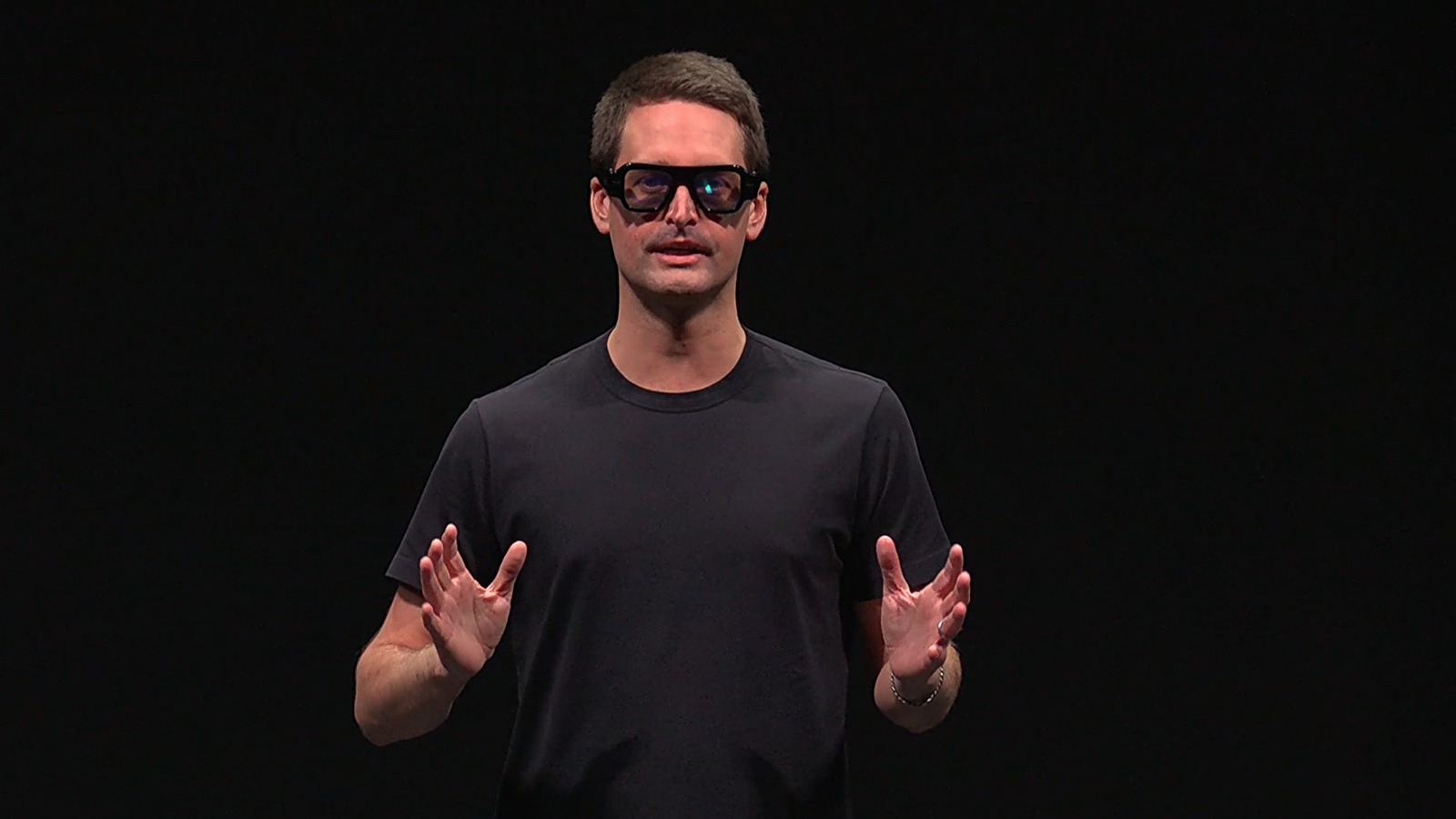
Snap held its first in-depth event for Specs on Wednesday, September 16, 2026, in Los Angeles, and the news wasn't the price — that had been public since June. It was everything around it. Per Snap's own announcement post, the $2,195 AR glasses will ship "later this fall" in the United States, United Kingdom and France; a Connected Case with Cellular pushes the bundle to $2,395; and Specs Intelligence, an AI service Snap is shipping to iPhone and Mac before the hardware arrives, is available now. Bloomberg, which got an interview with CEO Evan Spiegel the same day, reported the Verizon partnership alongside it. The first production run is capped at roughly 100,000 units.
That last number is the one worth holding onto. Snap is not trying to sell a lot of these. It is trying to prove that a self-contained pair of see-through AR glasses — no puck, no tether, no phone required — is a product category at all, and it has spent more than $3.5 billion finding out, per Fortune's September 18 report. On privacy, Snap stated plainly that personal content from connected accounts will not be used to train or fine-tune its AI models.
The cellular case is the genuinely new hardware
Everything about the glasses themselves was already on the record from Snap's June 16 unveil at AWE in Long Beach. What Snap added on September 16 was connectivity. The Connected Case with Cellular is a charging case that also gives Specs a standalone data connection, sold as a $2,395 bundle rather than a separate accessory. Verizon is the US carrier partner: data plans start at $10 a month for existing Verizon customers and $20 a month for everyone else, with 36-month financing for eligible buyers, and Verizon stores will carry demo units. Snap named Orange in France and EE in the UK as the equivalent partners in its other two launch markets.
Calling a charging case the most interesting announcement sounds like faint praise, but it's the piece that decides whether these are glasses you wear out of the house. A standalone AR device that needs a phone tether is a phone accessory. One with its own SIM is not. Writing at The Ghost Howls on September 17, Antony Vitillo — who has covered XR hardware for a decade — called the cellular case "the biggest innovation announced today."
Snap opens a public "First Look" demo experience at Westfield Century City in Los Angeles on October 1, 2026, per its announcement. Preorders have been open since June at specs.com with a $200 refundable deposit. Shipping is still only committed to "later this fall" — Snap did not give a hard ship date at the event — and only in the US, UK and France.
Specs Intelligence ships before the glasses do
The software layer got more stage time than the hardware. Specs Intelligence is what Snap describes as an anticipatory AI service, running across iPhone, Mac and the glasses themselves. Per Snap's announcement, it's "designed to anticipate when help would be useful and surface relevant information and actions at the right moment" — it reads connected accounts like calendar and reminders and pushes information at you rather than waiting to be asked. It's available in September 2026 on iOS for users 18 and over, with Mac access behind an early-access waitlist.
Shipping the assistant to phones and laptops months before the glasses is a deliberate move, and AR Insider read it the obvious way in its September 17 write-up: it lets people build a habit around the service before they're asked for $2,195 of hardware to complete it. It also hedges. If the glasses stay niche, Snap still has an AI product with a distribution path that doesn't depend on selling 100,000 headsets.
The partner list is where the strategy actually shows
On the consumer side Snap named the NBA and WNBA for a basketball training app, HBO Max for a Harry Potter tie-in, Shopify to put its full merchant catalog into AR at real-world scale, plus Alo Wellness Club, Tripadvisor and Spotify. AR Insider notes the translation feature covers 60 languages. Snap's own Lens Studio remains the creator tool, leaning on a Lens developer community it has been building for over a decade.
The enterprise list is the more telling one. Salesforce is embedding its Agentforce platform so workers can reach company data through the glasses; Nvidia is supplying AI that interprets what a worker is looking at and pulls the relevant internal information; Amazon is contributing cloud assistant technology for voice tasks like checking warehouse stock. Vitillo's account adds HoloLight and Trifork. Spiegel framed it to Fortune as removing friction: "The goal with both Salesforce and Nvidia is to make it really easy for businesses to get the benefits." Per 24/7 Wall St., none of the partnerships came with disclosed financial terms.
There is a real hole in that enterprise story, and Vitillo flagged it: Specs don't support Unity or Unreal Engine. Most industrial XR software is built in one or the other. An enterprise pitch that requires rewriting in Lens Studio is a much harder sell than the partner logos suggest.
What the hardware is, per the June spec sheet
Snap did not re-disclose hardware numbers at the September event, and notably left battery life, weight and field of view out of the announcement post. The figures from the June unveil, as reported by Road to VR: a 51-degree field of view using proprietary liquid-crystal-on-silicon displays, roughly 30 percent more display area than the fifth-generation Spectacles, two Qualcomm Snapdragon chips, 132g and 136g in two sizes (about 40 percent lighter than the previous generation), up to four hours of mixed-use battery extending to around 20 hours with the case, and hand and voice input with prescription inserts supported. Snap describes the virtual display as feeling like a 115-inch screen about 10 feet away, and demonstrated a Travel Mode that keeps it stable while you're moving.
Four hours is the number the skeptics keep returning to. CCS Insight analyst Ben Hatton told the BBC that "despite the impressive features and experiences available through Specs, glasses with a 4-hour mixed-use battery life and bulky design are not going to replace the smartphone any time soon." After the June unveil, Benchmark's analysts summarised the comparison to rivals as twice as heavy, three times the price, and shorter battery life.
$3.5 billion in, with an activist on the register
The financial backdrop is the part of this story that gets undersold. Snap spun Spectacles out into Specs Inc., a wholly-owned subsidiary, on January 28, 2026 — structurally separate, still Snap's money. Activist investor Irenic Capital Management, which CNBC reported in March 2026 had built a stake in Snap, has argued the Specs business should be funded on its own rather than out of the core company, and has pushed a broader cost-cutting and restructuring program. Fortune's September 18 piece puts the program's spend to date above $3.5 billion.
For scale on how badly this can go: Fortune notes Meta's Reality Labs racked up $88.1 billion in losses between 2019 and 2025, and Meta is a company that can absorb that. Snap is not. Spiegel is not backing off — the September event was, if anything, a more expansive bet than June's, adding an AI service, an enterprise stack and a carrier relationship on top of the hardware. But a capped 100,000-unit first run is what a company builds when it needs the bet to be survivable.
The market reaction, and what lands next week
June's reception was brutal: per Stocktwits' June 17 report, Snap shares shed 17 percent across the two sessions following the price reveal. September went the other way. On Thursday, September 17, SNAP rose about 4 percent to $5.95 on the enterprise partnership news, per 24/7 Wall St., which also noted Meta barely moved, up 0.4 percent to $675.88 — investors reading Snap's enterprise angle as adjacent to Meta's consumer glasses rather than aimed at them.
That comparison gets tested almost immediately. Meta Connect runs September 23 and 24 at Meta's Menlo Park campus, and Meta's own event page points at AI glasses, including its $799 Ray-Ban Display with the Neural Band. Snap's $2,195 glasses cost roughly three times that. The direction of travel in the category favors both of them over headsets: Counterpoint Research's Q2 2026 XR tracker, published September 8, had AR device shipments up 138 percent year over year while VR headset shipments fell 18 percent.
So the honest read on September 16 is that Snap answered the questions it could answer — what it costs to connect, what the AI does, who's building for it, where you can try it — and left the one that matters open. It still hasn't said when these ship, and it hasn't published a battery or weight figure since June. A fall window and a 100,000-unit run is a company saying: we'll find out together.
When do Snap Specs actually ship?
Snap has only committed to "later this fall" in the US, UK and France, per its September 16, 2026 announcement — no specific date was given at the launch event. Preorders take a $200 refundable deposit, and a public demo experience opens October 1, 2026 at Westfield Century City in Los Angeles.
What does the cellular version cost to run?
The Connected Case with Cellular bundle is $2,395 versus $2,195 for the glasses alone. Verizon data plans start at $10 a month for existing Verizon customers and $20 a month for non-customers, with 36-month financing available for eligible buyers. Orange covers France and EE covers the UK.
Can I use Specs Intelligence without buying the glasses?
Yes. Per Snap, the service launched in September 2026 on iOS for users 18 and over, with Mac access via an early-access waitlist, and it runs independently of the hardware.