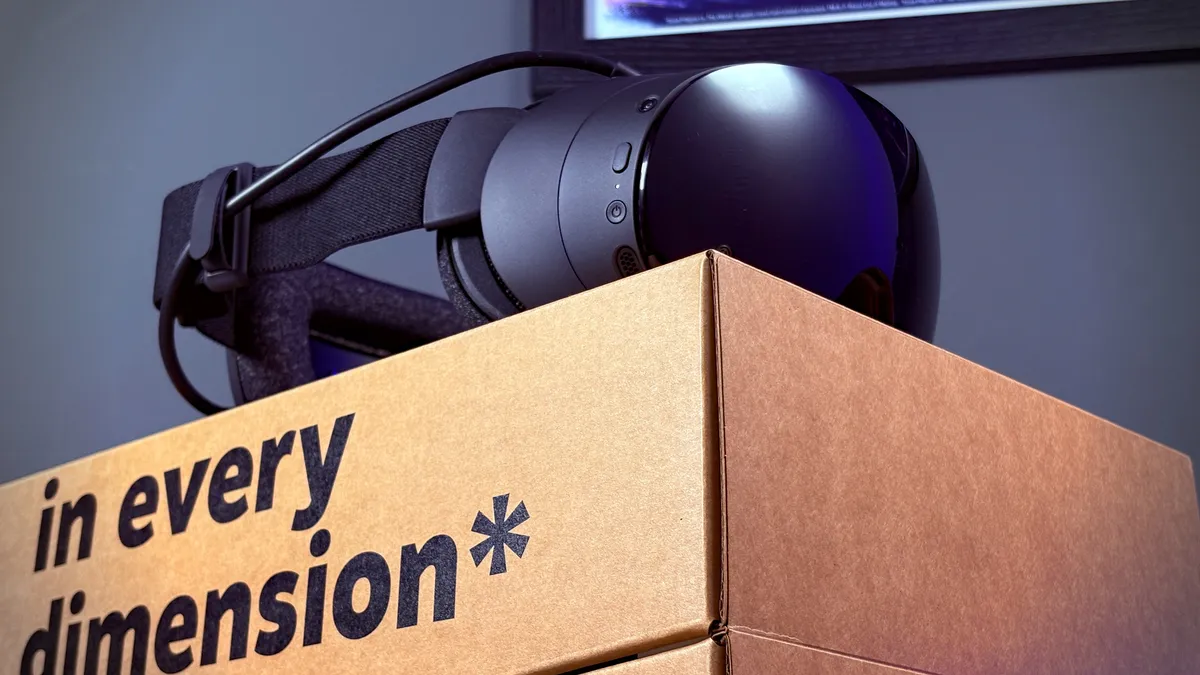
Valve put a price on Steam Frame on Monday, September 14, 2026: $1,059 for the 256GB model and $1,299 for the 1TB version, per Valve's announcement as reported by Road to VR and UploadVR. Reservations opened the same day, and they are a randomized lottery rather than a first-come queue. That lottery closes today, Thursday, September 17, at 10 AM Pacific — UploadVR quoted Valve's window as "exactly 72 hours" — with the first purchase emails going out Friday, September 18, which is also when the headset begins shipping.
The price was the one number the entire pre-launch cycle had been missing. Valve had promised the Frame for "this summer" and, through a major SteamVR update and a leaked unboxing video, still hadn't said what it cost. Now it has, and the answer puts the Frame in a different bracket from the standalone headsets it will sit beside: reviewers noted repeatedly that the 256GB Frame costs more than double Meta's Quest 3S. Valve isn't competing on price, and the reviews that landed on launch day make clear it isn't pretending to.
What $1,059 buys
Steam Frame is a standalone SteamOS headset built around a Qualcomm Snapdragon 8 Gen 3 with 16GB of RAM. Engadget's review lists dual LCD panels at 2,160 x 2,160 per eye behind pancake lenses, running 72Hz to 144Hz, with the 144Hz mode marked experimental, and storage as 256GB or 1TB UFS plus a microSD slot. UploadVR reports four onboard grayscale cameras handle tracking, two of which also drive the monochrome passthrough, and that eye tracking is used for foveated streaming. No base stations are required. Weight is where the Frame clearly wins: Engadget measured it at 440 grams against the Quest 3's 515 grams, and Gizmodo's Kyle Barr put it at 0.97 pounds versus 1.14 for Quest 3 and 1.65 for Vision Pro.
Valve's framing is "streaming-first." A USB dongle in the box creates a point-to-point 6GHz Wi-Fi 6E link between a PC and the headset, but Road to VR is explicit that the Frame does not need a VR-ready PC — or a PC at all — to work. It plays native titles on its own silicon and can throw the flatscreen Steam library onto a virtual screen.
What isn't in the box is a power supply. Per Road to VR's breakdown of Valve's accessory pricing, the 45W unit is a separate $29. An Ergonomic Kit — two hand straps, two battery doors, a headset strap and a light blocker — runs $59, and a Replacement Kit with face gasket, head cushion and light blocker is $49. Color passthrough is also an add-on: UploadVR reports the Frame's built-in passthrough is monochrome only, with color mixed reality and 3D video capture requiring the separately sold $149 Arcturus Vision Camera.
Registrations submitted during the 72-hour window are randomized to assign queue positions equally, per UploadVR, and purchase offers go to whoever's position matches available inventory. Anyone registering after the window joins an automatic waitlist. Road to VR notes the approach mirrors Valve's Steam Machine pre-orders and is aimed at limiting resellers.
Valve said the standalone Alyx wouldn't make launch, then shipped it the next day
Every Steam Frame includes a copy of Half-Life: Alyx, per UploadVR. The more interesting part is the native build. On September 14, Road to VR reported that Valve had confirmed the standalone ARM port would not be ready for launch, saying only that it was "intended to ship to customers soon," with no date attached.
It arrived the following day. GamingOnLinux reported on September 15 that the ARM64 port shipped as a regular Half-Life: Alyx update, quoting Valve's patch notes: "Ported the game to ARM64/aarch64," plus "Added foveated rendering support when running standalone on Steam Frame" and "Added support for depth reprojection when running on Steam Frame, allowing smooth gameplay at lower framerates." The notes also cite "significant rendering and performance optimizations" for the hardware. So the headline pack-in will run natively on day one after all — three days ahead of the first units going out, and a day after Valve implied it wouldn't.
The library numbers need reading carefully
Valve's launch post advertised over 100 games carrying the Steam Frame Verified tag, and VR.org counted 130 titles as of September 11. Those are not 130 VR games. UploadVR puts the native VR count at 70 titles confirmed to run and perform well standalone, and VR.org is blunt that "most of that growth is flatscreen Steam catalog games rather than native VR," listing Balatro, Cuphead and Hollow Knight: Silksong as examples — games played on a virtual screen, not in VR.
The certification thresholds explain the gap. Per VR.org, a standalone VR title has to hold at least 72fps at 1728x1728 per eye to be verified, while a certified flatscreen title only needs 720p at 30fps. VR.org also clarifies the naming, which Valve has muddled somewhat: Steam Frame Verified is the certification program, and "Great on Frame" is the storefront page collecting the games that passed it.
The reviews split, and battery life is why
Launch-day reviews were not unanimous. Engadget's Devindra Hardawar scored it 6.5 out of 10 under the headline verdict that it's "solid standalone VR that's too little, too late," writing that "a $1,059 VR headset today is just madness" and that the Frame "feels like a device that should have shipped five years ago." His conclusion was that it's "really something only meant for Steam VR enthusiasts." CGMagazine was far warmer, scoring it 8 and calling it a spiritual successor to the Valve Index and a marked improvement for standalone headsets generally.
The streaming is the part nobody disputes. Gizmodo's Barr reported "no interruptions, no lost packets, and no sudden blurry visuals" streaming Alyx over the included dongle, measuring roughly 30ms latency in the 2D games he tested. His verdict threads the needle: "The Steam Frame offers the best PC VR experience, but that may say more about how gaming-focused headsets have stalled."
Battery life is the consistent complaint, and the numbers depend heavily on what you're doing. Engadget got about two hours from video and light gaming and just under 90 minutes from Alyx. Gizmodo measured roughly one hour running native VR — Alyx and Superhot VR — on the headset's own chip, with streaming stretching past two hours. The other recurring gripe is that monochrome passthrough, which Gizmodo described as useful mainly for not banging your legs on the furniture.
Launching into a contracting market
The timing is awkward in a way that isn't Valve's fault. Counterpoint Research refreshed its quarterly XR tracker on September 8, and as reported by VR.org's Sam Whitfield on September 11, global VR headset shipments fell 18 percent year over year in Q2 2026 and 16 percent quarter over quarter. AR devices went the other way, up 138 percent year over year. Meta's share of combined XR shipments slid to 54 percent from 58 percent in Q1 2026 and 72 percent in Q2 2025.
Counterpoint named enterprise and robotics as the exceptions holding up, pointing to buyers who are "generally less price-sensitive" and to demand — particularly from China — for VR headsets used in data collection and remote robot control. The consumer VR category, in other words, is the part that's shrinking, and that's the category a $1,059 headset is being sold into. Cost pressure is visible on the hardware side too: Gizmodo tied the Frame's price partly to the ongoing RAM pricing crisis, and Counterpoint noted Meta raised its own headset prices amid the global memory surge.
Meta Connect follows almost immediately, on September 23 and 24 at Meta's Menlo Park campus per UploadVR, and expectations point at smart glasses rather than a new headset — consistent with which half of the XR market is actually growing. Valve, meanwhile, has shipped the most technically accomplished PC VR headset anyone has made and priced it for the people who were always going to buy it.
When does Steam Frame actually ship?
First purchase emails go out September 18, 2026, which is also when units begin shipping, per Road to VR. Reservation signups closed September 17 at 10 AM Pacific; anyone registering later joins an automatic waitlist, per UploadVR.
Is Half-Life: Alyx included, and does it run without a PC?
A copy ships with every Steam Frame, per UploadVR. The native ARM64 build that runs standalone on the headset went out as a game update on September 15, 2026, per GamingOnLinux — after Valve had said a day earlier it wouldn't be ready for launch.
Do I need a gaming PC to use it?
No. Road to VR reports the Frame runs SteamOS and plays native titles on its own hardware, with no VR-ready PC and no base stations required. The bundled Wi-Fi 6E dongle is there for streaming a PC library when you want it.